
Picture a Thursday meeting. This is a composite, not a client.
The head of security has the new homepage draft open. “We can’t say it stops attacks. It detects and contains anomalous behavior. Someone will quote ‘stops’ back at us.”
The marketing lead answers, “Nobody books a demo to see anomalies contained.”
Both nod at the screen. Neither moves. The draft goes back out with a compromise headline that is accurate and says nothing.
Security and marketing talk past each other because each protects something different: security protects accuracy, marketing protects attention. With no shared reference to point at, every headline becomes a negotiation, and the compromise usually satisfies neither buyer.
Neither side is being difficult. A security lead who lets one false claim through loses credibility with every technical buyer. A marketing lead who lets a dense headline through loses the visitor in seconds. A CMO Council and KPMG report found that a third of marketing and security partnerships are not collaborating effectively. cmocouncil
It shows up in four places.
The homepage headline is the compromise. The sales deck has slides from both camps and flows like it. The demo opens with a product overview that engineering approved. Analysts call the root habit the feature fallacy: messaging built around what the product is instead of what it does for the buyer. thecuberesearchthecuberesearch
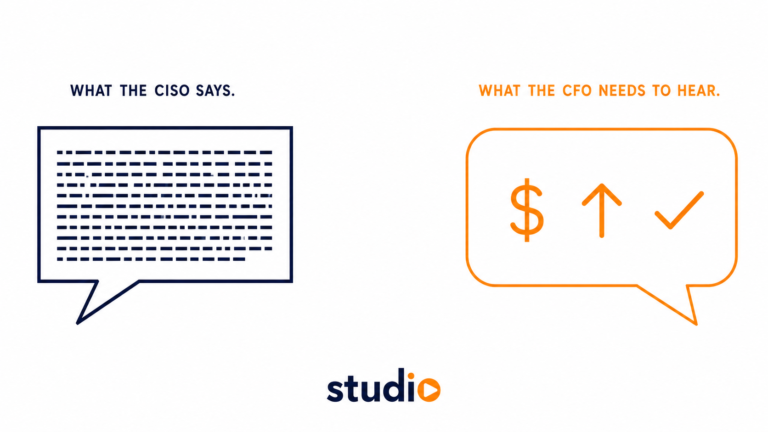
Then the buyer’s champion has to explain it to a CFO. Only 52 percent of finance leaders say they are very confident their security team can communicate business impact clearly. That translation gap runs both directions. secureworld
Here is a hypothetical. Say your homepage gets 2,000 visitors a month and converts at 1.5 percent: 30 demo requests. If clearer messaging lifted it to 2.5 percent, that is 50. The argument in that Thursday meeting costs you 20 conversations a month.
The fix is giving both teams something to approve besides adjectives.
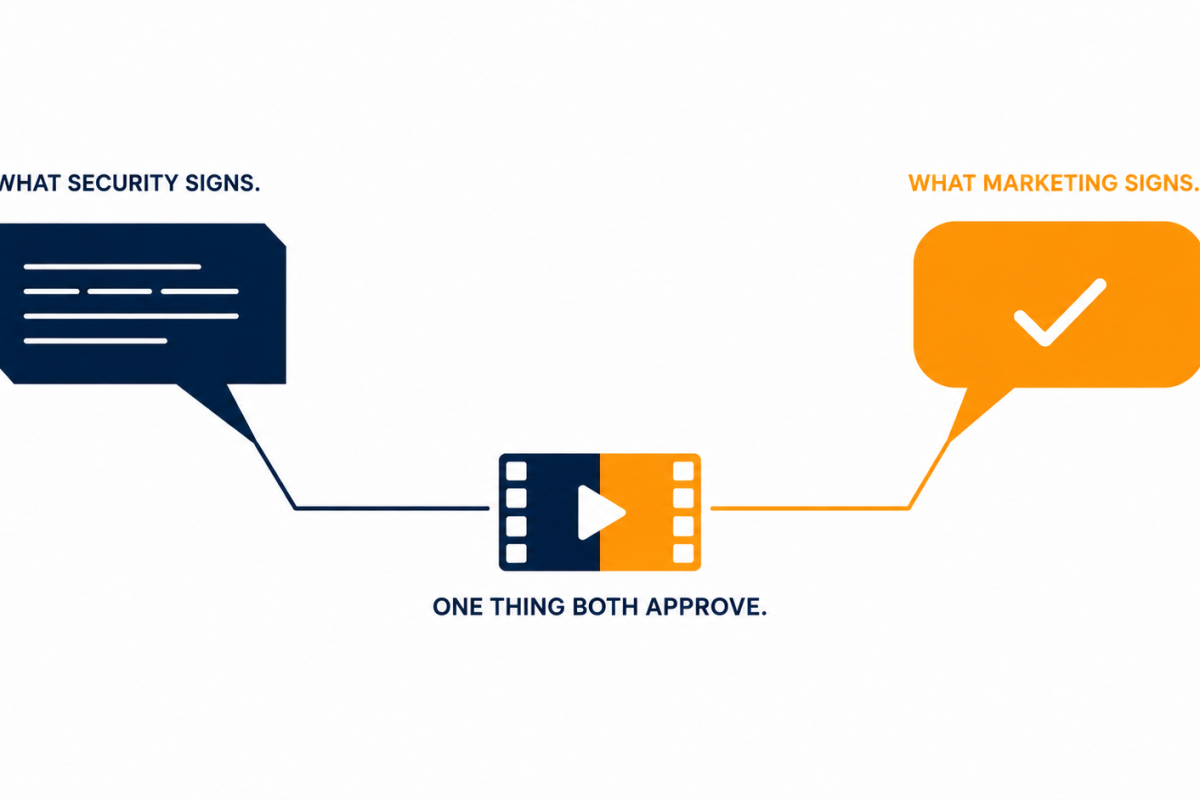
A 60-second animation works because the argument changes. Security checks the sequence: does the stolen credential get caught the way it really would? Marketing checks the story: does a CFO feel the risk and the relief? Arguing over frames is faster than arguing over wording. Both teams sign the same asset, and the buyer’s champion can forward it.
You can see how this works on complex cybersecurity products. See the portfolio →
A video will not decide who has final say. If nobody owns the message, the storyboard gets the same fight. Settle who signs off before you commission anything.
If your two teams are on their third rewrite of the same headline, book a Call → and I will tell you where the argument is really stuck.
Approve the story, not the adjectives.
Ayan Wakil
Their risks differ. Engineers fear a claim that turns out false. Marketers fear a message nobody reads. Both fears are reasonable, which is why the argument never ends on its own.
Split the approval. Technical signs off on facts: what the product does and which claims hold up. Marketing signs off on wording and order. Write a one-paragraph fact sheet first, and the wording fights get much shorter.
One reference both teams approve once and reuse: a fact sheet, a storyboard, a short video. Analysts recommend a single source of truth for external messaging. It ends arguments by giving people something to point at. securitymagazine
Start with one buyer: who approves the budget, and what do they need to feel? Agree on one outcome sentence. Then set a recurring sit-down so the two never meet only when something breaks. centricconsulting

Hi, I’m Ayan Wakil, the founder & CEO of Ayeans Studio.
Check out these and many other tips in our blog!