
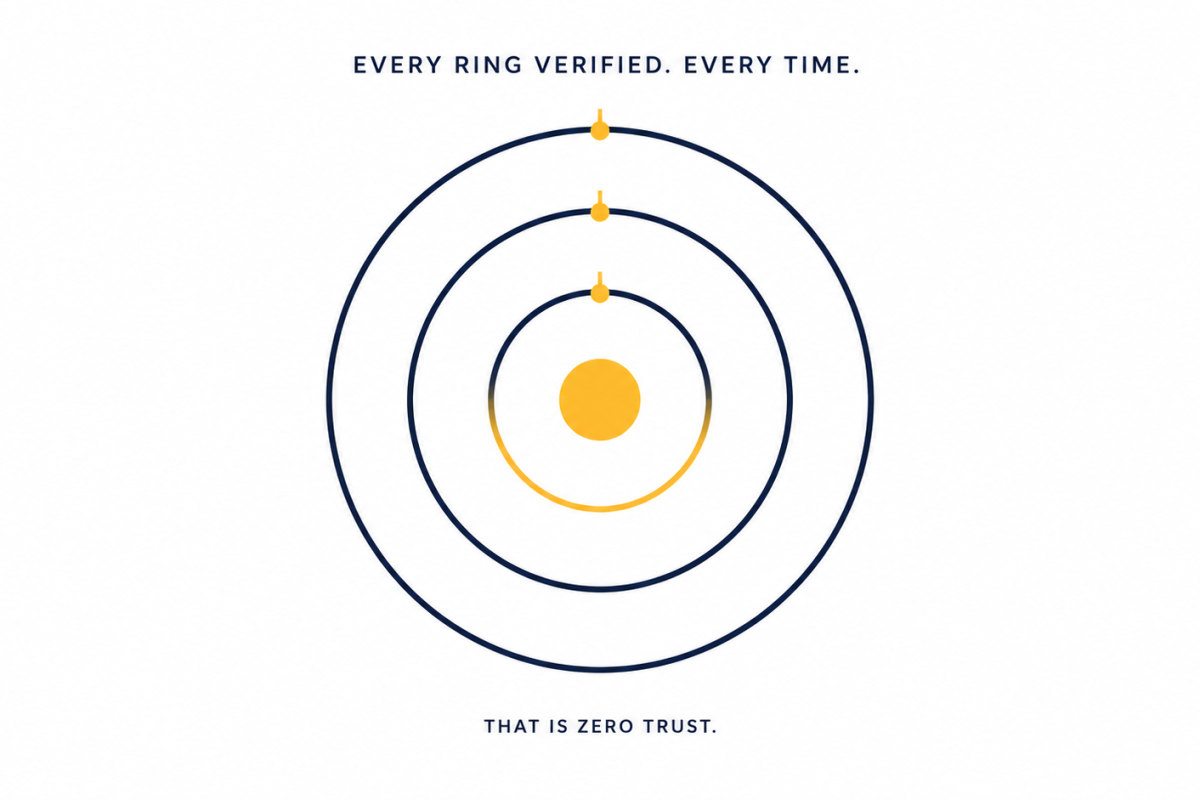
Zero trust is a security approach that requires every person and every device to prove they are allowed access, every single time, regardless of whether they are already inside the company network. It does not mean you distrust your employees. It means that a stolen credential alone is no longer enough to move freely through your systems.
That definition took two sentences. Most zero trust pitches to a CFO take forty minutes and still leave the room confused.
Here is why that happens, and what to do instead.
The CISO has done the work. They have evaluated vendors, scoped the implementation, and built the business case. They walk into the budget meeting ready.
Then the CFO asks the question that ends it.
“What exactly are we buying?”
And the CISO explains continuous verification, least privilege access, and microsegmentation. Accurately. Thoroughly. In language that means everything to a security engineer and nothing to a finance leader trying to decide whether to approve a six-figure spend.
You can be right about risk and still lose the budget conversation. When security discussions do not plainly connect to business priorities, they are easy to deprioritize. That is not an opinion. That is what the Cloud Security Alliance found when they looked at why security budget requests get denied.
A CFO makes budget decisions based on three things: what the risk is in financial terms, what it costs to ignore it, and what success looks like in a measurable way.
None of those things are answered by “we’re implementing a zero trust architecture.”
Here is what answers them.
Those three answers fit on one slide. You don’t need to explain the entire framework before the CFO says yes.
Here is the part that rarely gets addressed.
The CISO is not the only person who has to explain this.
After the budget meeting, the CFO talks to the CEO. The CEO mentions it to the board. Each retelling gets slightly less accurate and slightly less confident. By the time it reaches the person whose signature the deal actually needs, the explanation has degraded into something vague.
That is where most zero trust deals die. Not in the room with the CISO. In a conversation the CISO was never part of.
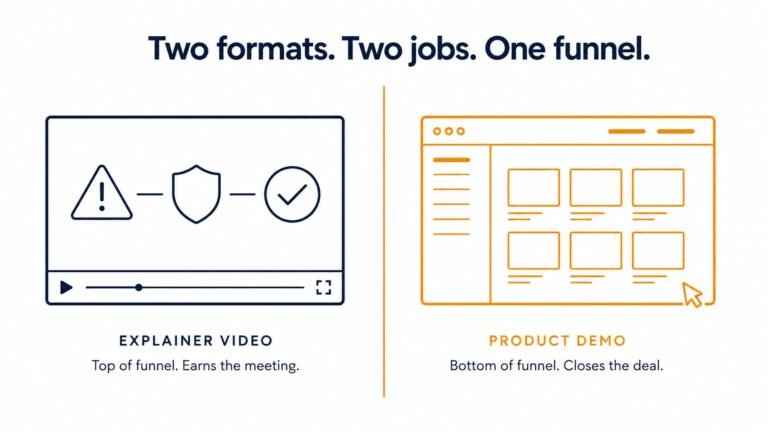
The fix is giving every stakeholder something they can watch and share themselves, without having to explain it first.
A short animated video can show zero trust working without once using the technical name for what it is doing.
An attacker uses a stolen credential to log in. The system checks identity, checks the device, checks whether the access request matches the user’s normal behavior. Something is off. Access is denied before any data moves. The company continues operating. Nobody outside the security team knows how close it came.
The CISO watches that and thinks: yes, that is technically accurate.
The CFO watches that and thinks: I understand what I am approving and why it matters.
The CEO can forward it to the board without having to explain anything first.
That is the internal selling problem, solved. Not by better PowerPoint. By a format that carries both accuracy and clarity in the same 60 seconds.
You can see how this works for complex cybersecurity products at ayeansstudio.com/portfolio.
If your zero trust pitch is technically solid and keeps stalling at the CFO stage, the explanation is the problem, not the product and not the price.
Book a free 15-minute call here and I will tell you honestly where the story breaks and what a visual translation would look like for your specific product and your specific buyer.
The CFO does not need to understand zero trust. They need to understand what your company avoids by having it.
Ayan Wakil
Zero trust is a security approach that requires every user and every device to verify their identity before accessing company resources, every single time, regardless of whether they are already inside the company's network. Traditional security models treated everyone inside the network as trustworthy by default, the way a locked front door assumes everyone already inside the building belongs there. Zero trust removes that assumption. Even an employee who is already logged in has to keep proving they are doing what they are supposed to be doing. The practical effect is that an attacker who steals a login credential cannot move freely through your systems, because a password alone is no longer enough to grant access.
Because vendor marketing complicated it. Forrester coined the term in 2010 as a specific architectural principle. Within a few years, dozens of vendors had attached the label to products that delivered a fraction of the actual framework, and the term stopped meaning one clear thing. Security professionals who work with the framework daily still use precise language because precision matters when you are building the controls. Non-technical buyers hear that precision and experience it as jargon they cannot decode. The concept underneath is genuinely simple. The language that grew up around it is not.
Lead with the business consequence, not the framework. Start with the specific risk in dollar terms: the average breach now costs $4.88 million, and a significant portion happen through compromised credentials that older security models would have let through unchallenged. Then explain what zero trust prevents in plain language: an attacker using a stolen password cannot move through your systems because the system checks more than just the password. Then give them a number: Forrester's research found 111% ROI and a five-month payback on a representative deployment. Those three things, risk, mechanism, return, are what a CFO needs to make a decision. The architectural explanation can come later, if they ask.
Partly, and it is worth being direct about this. The term has been applied to so many different products that it lost some of its meaning. Gartner found 35 percent of firms attempting zero trust initiatives failed due to poor planning and vendor confusion. That failure rate is real. What is also real is that the underlying principle is sound and well-documented. NIST Special Publication 800-207 provides a rigorous framework. The US federal government has mandated zero trust adoption across civilian agencies. The DoD requested nearly $1 billion specifically for zero trust transition in its 2025 budget. The hype attached to the label is a problem. The security approach underneath the label is not.

Hi, I’m Ayan Wakil, the founder & CEO of Ayeans Studio.
Check out these and many other tips in our blog!
We provide services that successfully satisfy your Business Objectives
Ayeans Studio is a German-based Video Production Company, all set to deliver our pride services to US-based Clients