
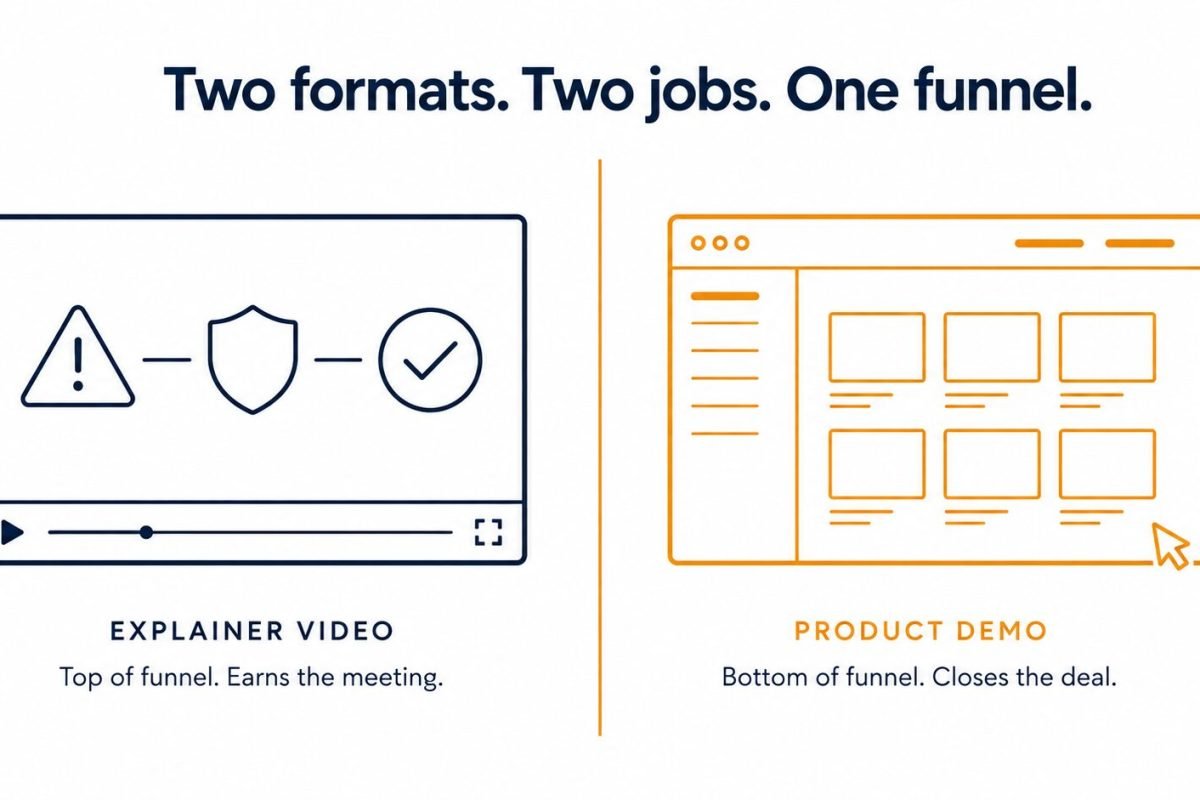
An explainer video earns the meeting. A product demo closes it. Those are different jobs and most B2B SaaS companies are mixing them up, using demos where explainers belong and explainers where demos would actually convert.
Here is how to think about which one you need and when.
An explainer video answers one question: what does this product do and why should I care.
It does not show the interface. It does not walk through features. It shows a problem, the product stepping in, and the outcome. Usually in under 60 seconds. Usually with no prior knowledge required from the viewer.
A product demo answers a different question: how does this actually work and does it fit what I need.
It shows the real product. Dashboards, workflows, integrations, specific features. It assumes the viewer already understands the category and is now evaluating whether yours is the right tool for their situation.
A demo tends to reward attention from warmer prospects. An explainer tends to attract the attention of colder audiences who still need context. Explain Visually
That single difference in audience warmth is the whole framework.
At the top of the funnel, your visitor is a stranger. They landed on your homepage from a LinkedIn ad, a Google search, or a colleague’s recommendation. They do not yet know if your product is relevant to them. They are not ready for a demo. They need 60 seconds of clarity first.
Put an explainer here. Not a demo.
At the middle and bottom of the funnel, the buyer is warmer. They have already expressed interest. They are comparing options. They want to see the actual product before committing to a sales conversation.
Put a demo here. Not another explainer.
SaaS companies with an explainer video on their homepage see 20 to 30 percent higher conversion rates on average compared to those without any video.
That number makes sense when you understand the mechanic behind it. The explainer removes confusion before the visitor decides whether to stay. Demos do not do that job. A confused visitor will not watch a 4-minute feature walkthrough.
I see two specific mistakes repeat across cybersecurity and technical SaaS homepages.
The first is a demo where an explainer should be.
A security company puts a 5-minute product walkthrough in their hero section. Their team is proud of it. It shows every feature in detail. But the visitor who lands on that page at the awareness stage does not want 5 minutes of a dashboard they do not yet have context for. They want to understand the product in under a minute. They leave before the demo gets to the valuable part.
The second is an explainer where a demo should be.
A prospect is on their third call with a sales team. They understand the product broadly. They want to see how the threat investigation workflow actually runs inside the product. The team sends them another short explainer. It explains the category they already understand. The prospect gets nothing new and the deal stalls because nobody showed them the product behaving the way they needed to see it.
Trying to force an explainer and a demo into a single asset often results in a piece that is too long for awareness and too shallow for serious evaluation. Explain Visually
That is the trap. One asset trying to do two jobs ends up doing neither.
There is a practical difference worth knowing.
Product demos show your actual UI. Every time you ship a significant update, the demo is out of date. If your product ships major changes quarterly, that is a real budget and time commitment.
Explainer videos, because they are conceptual, typically last 1 to 3 years before needing a refresh. When you factor in shelf life, a video that lasts 2 years has a lower annual cost than a demo video that needs updating twice a year.
If you can only make one video right now, the explainer is the more durable investment. It earns you the meetings. The demo can come later, once you have a room to show it in.
If your homepage is losing visitors before they ever get to a demo call, the explainer is the missing piece.
You can see what this looks like for complex technical and cybersecurity products at ayeansstudio.com/portfolio.
If you want to talk through which format your funnel is actually missing right now, book a free 15-minute call here. I will tell you honestly whether you need an explainer, a demo, or whether the gap is somewhere else entirely.
The right video in the wrong place does nothing. Match the format to the question your buyer is actually asking at that moment.
Ayan Wakil
It depends on where your buyer is in their decision. If they are visiting your homepage for the first time and still figuring out whether your product is relevant to them, use an explainer video. It answers the question "what does this do and why should I care" in under 60 seconds without requiring any prior knowledge. If the buyer has already expressed interest and is now comparing your product against alternatives or deciding whether to buy, use a product demo. It answers the question "how does this actually work and does it fit my needs" with real product footage and feature walkthroughs. If you can only make one video, make an explainer. It works at the widest range of funnel stages and has the longest shelf life. But if you are serious about video as a conversion tool, you need both, each designed for a distinct stage and purpose.
They convert different things at different stages, so the question is slightly off. If you want people to stop scrolling and engage at the awareness stage, explainer videos are much more effective. They do not require the viewer to have any prior knowledge. When it comes to converting a warm lead into a paying customer, demo videos are the stronger choice, since seeing the product in action is one of the top three factors in B2B buyer decisions. The mistake is measuring them against the same goal. Measure an explainer by how many first conversations it generates. Measure a demo by how many of those conversations convert to a paid commitment.
You can, but the risk is real. Trying to force an explainer and a demo into a single asset often results in a piece that is too long for awareness and too shallow for serious evaluation. A hybrid that tries to do both usually runs 3 to 5 minutes, which is too long for a cold homepage visitor and not detailed enough for a buyer who needs to see specific workflows. A cleaner approach is a short explainer on the homepage, under 90 seconds, and a longer demo video available on a dedicated product page or sent mid-funnel after a prospect has expressed genuine interest. Explain Visually
For homepage placement, 60 seconds is the practical ceiling. Wistia engagement data consistently shows viewer drop-off sharpens after 90 seconds on embedded homepage videos. The goal is not to explain everything. It is to create enough understanding that the visitor wants to book a meeting where the rest can be covered properly. Demo videos can run 90 to 120 seconds since viewers watching them are warmer and have more patience for detail. Match the length to the patience of the audience at that specific funnel stage, not to the comprehensiveness of what you want to say.
Yes, and for a specific reason. A free trial converts people who have already decided to try. An explainer video converts people who have not yet decided whether your product is worth trying. These are different populations and different moments. Without an explainer, the visitor who is not yet sure has no fast way to understand your product and will likely leave before reaching the free trial button. The explainer is what earns the click on the trial, not what replaces it.

Hi, I’m Ayan Wakil, the founder & CEO of Ayeans Studio.
Check out these and many other tips in our blog!
We provide services that successfully satisfy your Business Objectives
Ayeans Studio is a German-based Video Production Company, all set to deliver our pride services to US-based Clients