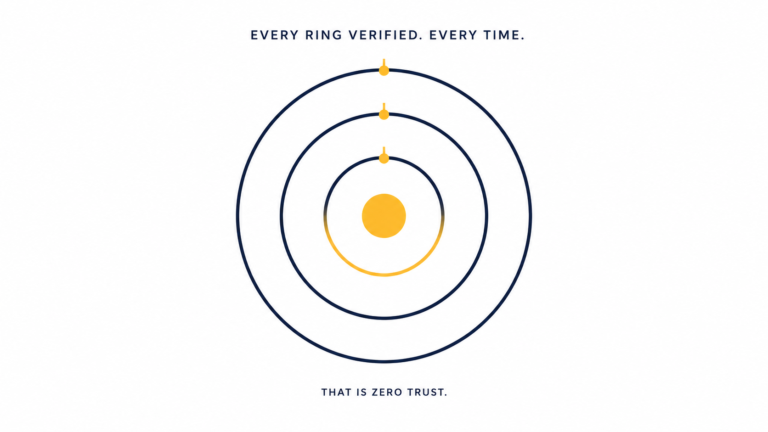

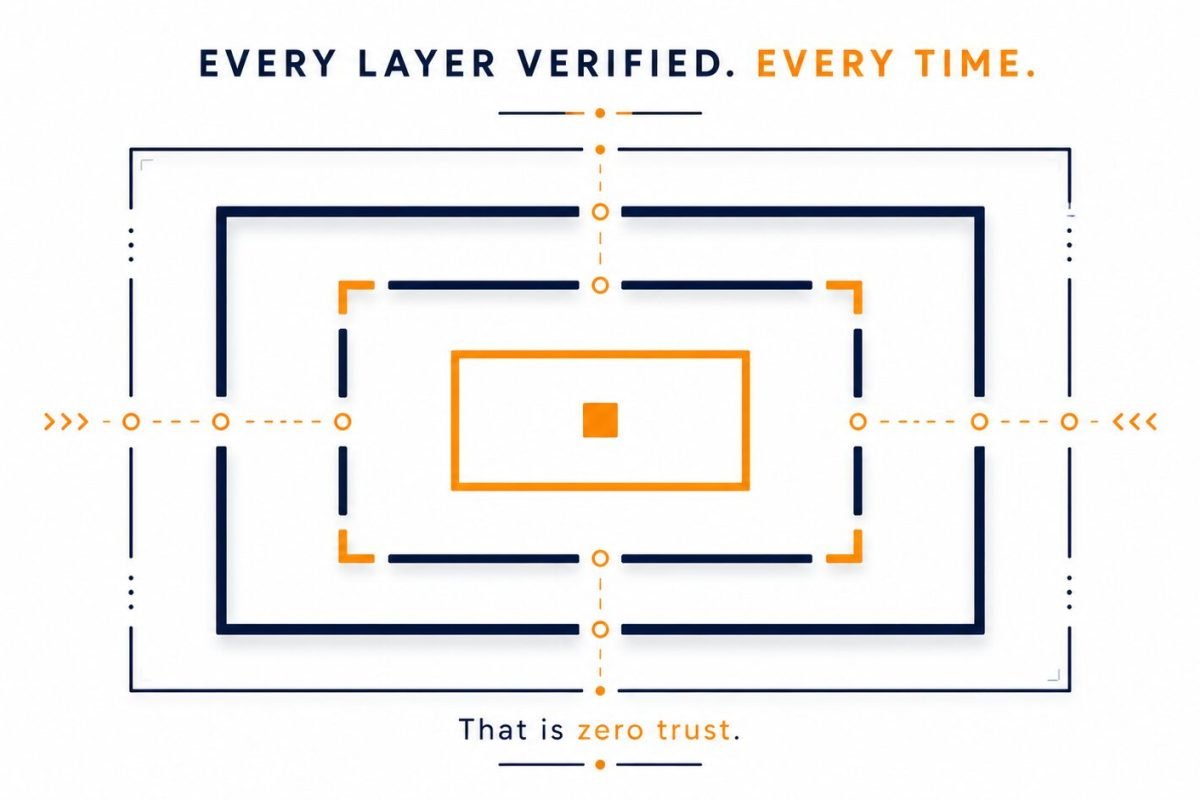
Zero trust is a security approach that requires every user and device to verify their identity before accessing company resources, every single time, regardless of whether they are inside or outside the company network. Unlike older security models that trusted anyone already inside the network perimeter, zero trust assumes that location alone is never enough to grant access.
That is the accurate version. Two sentences. A CFO could repeat it.
Most vendor homepages do not come close to this.
Picture the scene.
The CISO walks into the budget meeting confident. They have spent three months evaluating zero trust vendors. They know exactly why the company needs this. They open their slides.
“We need to implement a zero trust architecture to replace our perimeter-based model. This addresses lateral movement risk, enforces least privilege access, and enables continuous identity verification across our hybrid environment.”
Every word is accurate. Zero trust moves defenses from static, network-based perimeters to focus on users, assets, and resources. The CISO is describing this correctly. Cloud Security Alliance
The CFO across the table nods.
They understood “hybrid environment.” The rest landed as a confident blur of technical language.
The CFO hears a number with no obvious way to measure the return. They are all in the same meeting, hearing a different product. forrester
The CISO leaves thinking the meeting went well. The CFO sends a follow-up asking for “a bit more information before we commit.” The deal enters a delay that lasts two months. Not because the product was wrong. Because the explanation did not reach the person with the checkbook.
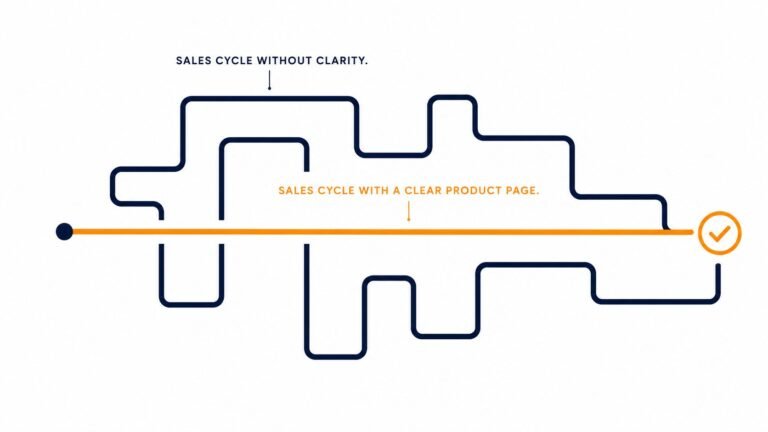
This is not an edge case. Enterprise security deals run nine to eighteen months on average. Most of them do not stall on price. They stall on understanding. forrester
When security conversations don’t clearly connect to financial impact, budget requests can stall. You can be right about risk and still lose the budget conversation.
Zero trust has a specific problem that makes this worse than most categories.
Zero trust architecture does not look like anything. XDR does not have a shape. SIEM is a process, not an object. You are asking a CFO to approve a significant spend on something they cannot see, cannot touch, and cannot easily picture working. forrester
The CFO doesn’t need to understand every technical detail. They do need to understand governance clarity, budget alignment, and how this investment scales with business growth. But most vendor pitches never frame it that way.
The result is a deal that stays in “late stage” for weeks while the CISO tries to translate an explanation that was never built for translation.
A 60-second animated video can show zero trust working without once using the phrase “zero trust.”
It can show an employee logging in from home. It can show the system quietly checking: is this the right person, on the right device, accessing the right thing. It can show the access granted, contained, and logged. It can show a second login, slightly off, flagged and blocked before anything sensitive is touched.
The CISO watching that video thinks: yes, that is technically accurate.
The CFO watching that video thinks: I understand what we are buying and why it matters.
Both things are true at the same time. That is what animation does for an invisible, technical concept that text alone struggles to make concrete.
You can see how this approach works for complex cybersecurity products at ayeansstudio.com/portfolio.
I want to be clear about something.
The answer is not to dumb down the CISO’s presentation. The technical accuracy matters. Enterprise buyers need it for their evaluation.
The answer is to add a layer of explanation that works for the CFO, the COO, and the board member who will never sit through the technical deep-dive but whose signature the deal requires.
A 60-second video on your homepage and in your sales process does not replace the CISO conversation. It gives the CFO something to understand before, during, and after it.
If you want to talk through what that looks like for your specific zero trust product, book a free 15-minute call here. No pitch. Just an honest look at where your explanation is losing the room.
Your CISO explains zero trust perfectly. The CFO approves what they understand, not what they were told.
Ayan Wakil
Zero trust is a security approach built on a core principle: never trust, always verify. Every access request is evaluated based on identity, device health, and context, regardless of location. In plain English: older security systems assumed that anyone already inside the company network could be trusted. Zero trust removes that assumption entirely. Every person and every device has to prove they are allowed to access what they are trying to reach, every time they try to reach it, whether they are in the office or working from home. It is not a single product you can buy and install. Zero trust is the overarching strategy that defines how access should be governed across users, devices, applications, and data. Think of it as a set of rules your security systems follow, rather than a single tool that enforces them. StereoscapeStereoscape
Because the CISO and the CFO are answering different questions. The CISO is evaluating technical merit and risk reduction. The CFO is evaluating financial return, governance clarity, and whether this spend makes sense relative to other priorities. When security conversations don't clearly connect to financial impact, budget requests can stall even when the security case is strong. The fix is not a better technical argument. It is framing the same product in the language the CFO already uses: risk to revenue, cost of a breach, operational continuity, and board-level liability. That translation rarely happens in a standard CISO presentation, which is built for technical approval, not financial sign-off.
It means something specific, but vendors have stretched the term enough that buyers are right to be skeptical. According to NIST Special Publication 800-207, zero trust is a set of cybersecurity paradigms that move defenses from static, network-based perimeters to focus on users, assets, and resources. That is a precise and meaningful definition. The problem is that many vendors now label almost any access management or identity product as zero trust regardless of whether it follows these principles. For a buyer evaluating vendors, the right question is not "do you support zero trust" but "how do you verify identity continuously, enforce least privilege access, and assume breach in your architecture." Those three questions separate genuine zero trust implementations from marketing labels. Cloud Security Alliance
Longer than most vendors suggest in their marketing. Zero trust is not a product you install over a weekend. B2B vendors selling into security-conscious enterprise customers typically work a 6-to-12-month sales cycle, with security review often the longest single stage. The implementation itself, after the purchase, depends heavily on the size of the organization, the complexity of the existing infrastructure, and how mature the identity and access management stack already is. A mid-market company starting from a reasonably modern baseline might see meaningful zero trust controls in place within 6 to 12 months. A large enterprise with legacy infrastructure is looking at a multi-year roadmap. CFOs who fund this well treat it as a multi-year roadmap, not a one-time purchase. oldham

Hi, I’m Ayan Wakil, the founder & CEO of Ayeans Studio.
Check out these and many other tips in our blog!
We provide services that successfully satisfy your Business Objectives
Ayeans Studio is a German-based Video Production Company, all set to deliver our pride services to US-based Clients